Science for Food, Peace, and the Future: A Conversation with Prof. Ademola Adenle
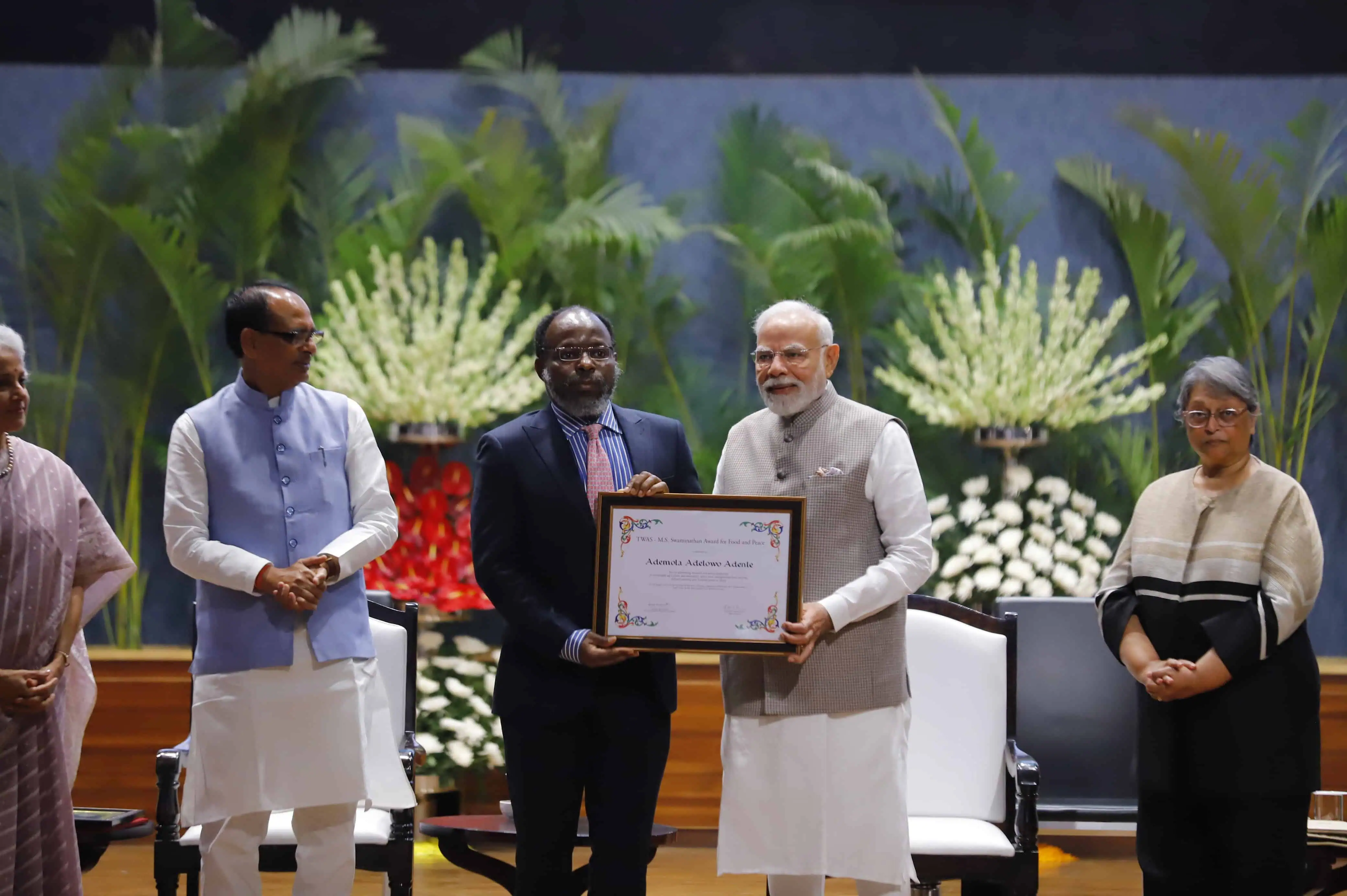
Professor Ademola Adenle, a Nigerian interdisciplinary scholar became the first recipient of the TWAS–M.S. Swaminathan Award for Food and Peace in August 2025. He has spent his career advancing science, food security, and sustainable development. In this conversation, he reflects on the role of science in addressing global food security, the legacy of Prof. M.S. Swaminathan, and why focusing on real-world problems is crucial.
How do you feel about receiving this award?
I feel deeply honoured and humbled to receive the TWAS–M.S. Swaminathan Award for Food and Peace. This recognition strengthens my commitment to advancing agricultural innovation, food security, and peace for rural communities worldwide.
You have had an amazing scientific career and have worked extensively in the areas of food security and green energy. What motivated you to pursue these fields?
As the son of a smallholder farmer, I witnessed firsthand the challenges of low agricultural productivity and its impact on farmers' livelihoods. When I was growing up and working on the farm with my father, I used to ask him, "Why are we always hiring people to work on the farm?" Most of the work, as you know, was quite tedious. He told me that we did not have the equipment or technology needed to make farming more efficient. Therefore, we had to rely on manual labour to get the work done.
At that point, I decided that I would study science when I grew up. Science and innovation were areas that I believed could help transform agricultural production in my country.
This inspired me to pursue a career in science and innovation, focusing on practical solutions that could boost agricultural productivity, improve resilience, and increase farmers' incomes. Innovation is essential not only for increasing productivity but also for improving livelihoods and raising income levels among farmers.
That motivation led me to study science extensively. I earned a bachelor's degree in Natural Sciences, a master's degree in Genetic Engineering, and later a PhD in Biosciences. My journey has been driven by the belief that science and innovation can transform agriculture and lift rural communities out of poverty.
Do you think we are on the path towards achieving the 2030 Sustainable Development Goals (SDGs)?
In developed countries, progress towards achieving Sustainable Development Goals is happening at a much faster pace. Is the same happening in developing countries? I do not believe so.
Many developing countries, particularly in Africa, are not fully on track to achieve the SDGs. Challenges such as inadequate infrastructure, limited access to finance, and shortages of expertise across relevant sectors continue to impede progress.
However, increased investment in science and innovation, better access to finance, and stronger infrastructure can help accelerate development. These efforts must be supported by effective national innovation systems and sound public policy. If policymakers fail to align policies with realities on the ground, governments will struggle to implement the SDGs successfully.
That said, credit must be given to several developing countries, including India, China, and Brazil, for making significant progress towards achieving the SDGs.
For example, between 2005 and 2021, India lifted more than 400 million people out of poverty. That is a remarkable achievement from an SDG perspective.
India is also the world's third-largest renewable energy producer. Its solar energy capacity increased from approximately 2.6 GW in 2014 to more than 70 GW in 2023. This is a significant achievement with regard to SDG 7: Affordable and Clean Energy.
The Swachh Bharat Mission has enabled the construction of more than 100 million toilets, helping make rural India open-defecation-free. This too is a noteworthy achievement.
Similarly, China has lifted more than 800 million people out of poverty since the 1980s, representing one of the greatest poverty reduction success stories in history.
Considering the award you have received, what are your upcoming research interests and projects?
Professor Swaminathan set a very high benchmark. Receiving an award in his name—and being its first recipient—is both an honour and a responsibility.
This recognition motivates me to work even harder and contribute something truly remarkable to the field of sustainable development.
My upcoming research will focus on a Women in Science initiative aimed at improving rural agricultural productivity, training, and entrepreneurship. The initiative will also address public health challenges such as malnutrition and waterborne diseases.
In addition, I intend to work on combating energy poverty through solar energy and renewable energy programmes in partnership with the M.S. Swaminathan Research Foundation across Africa and Asia. This work aligns with the broader mission championed by Professor Swaminathan.
What research and policy measures need to be developed in the Global South to address food security and energy challenges?
I believe the Global South needs research that delivers climate-resilient crops through sustainable farming practices, alongside affordable renewable energy solutions.
As I mentioned earlier, policy interventions should focus on improving access to finance, investing in rural infrastructure, empowering women and youth, and creating an enabling environment for innovation that can address food insecurity and energy poverty.
National governments should prioritise these areas. By doing so, they can tackle some of the fundamental challenges facing the agricultural, health, and energy sectors.
What have you found to be the most critical environmental factors affecting public health in African countries?
In Africa, poor access to clean water and sanitation remains a major challenge. Air pollution caused by the burning of biomass and fossil fuels is another critical issue.
Inadequate waste management is also a longstanding problem that many African governments continue to struggle with.
These environmental challenges contribute to a range of public health concerns, including heat stress, vector-borne and waterborne diseases, and food insecurity. Together, these issues significantly affect public health outcomes across the continent.
Governments should not ignore these challenges. They need to develop policies that address these issues effectively and promote environmental sustainability.
With your strong research background, you decided to pursue public policy. How has that impacted your career?
During my PhD at the University of Nottingham, I conducted extensive laboratory research in applied toxicology within the environmental sector.
After completing my PhD, I returned to Nigeria and began working at a private university. However, the institution lacked sufficient research facilities to support my work. As a result, I decided to transition into a policy-related field.
I subsequently joined the United Nations University and worked on biosafety policy. My focus was on developing comprehensive biosafety frameworks to facilitate the responsible adoption of genetically modified organisms (GMOs) in Africa.
Eventually, I led the largest study in the history of genetically modified agriculture in Africa.
After moving from laboratory research into policy work, I enrolled in the Master of Public Policy programme at the University of Oxford.
The programme provided me with a platform to engage with a wide range of stakeholders, including senior government officials, farmers, and private-sector leaders. Together, we explored how relevant policies could facilitate the adoption of new technologies to address sustainable development challenges.
I believe this interdisciplinary approach is one of the reasons I have been able to achieve success and ultimately receive this award.
What advice would you give young scholars?
I always encourage young researchers and emerging scholars to remain focused and courageous in pursuing their goals.
Developing strong research skills is essential. Equally important is focusing on real-world problems. You need to be specific, intentional, and persistent in the face of challenges.
If you do this, you will achieve a great deal, and your work will create meaningful impact while addressing important societal needs.
I also encourage scholars to collaborate across disciplines. Most importantly, align your work with social needs so that your research creates lasting and meaningful impact.
As told to Shriya Naidu, Science Communications Manager, MSSRF. This interview was conducted on 7 August 2025