First cohort of the M.S. Swaminathan Fellows graduate
Can lesser-known leafy greens become tomorrow's superfoods? Can seaweed become the next big healthy snack? Can microbes cut methane emissions from paddy fields?
These are some of the questions that the first batch of M.S.Swaminathan Fellowship attempted to answer. The first cohort completed its two-year journey of research and fieldwork on agriculture, sustainability, and nutrition and marked the end of the programme by presenting their research findings, key insights, and field experiences at MSSRF on 26 June 2026.
Launched in 2024, the fellowship was initiated with Prof. M.S. Swaminathan’s vision of an equitable, technology-driven future by bridging the gap between scientific innovation and societal impact. The programme was created to equip young researchers with real-world application of scientific knowledge to address pressing community challenges.
Over the two years, the fellows were mentored by senior researchers at the M.S. Swaminathan Research Foundation (MSSRF), The University of Trans-Disciplinary Health Sciences and Technology (TDU), CSIR-CFTRI and French Institute of Pondicherry gaining interdisciplinary exposure across Biotechnology, Agrobiodiversity, Health and Coastal Systems.
The first cohort took on real-world challenges that affect farmers, communities, and the environment.Their research included:
Praise Alex (MSc Food Science): Evaluated lesser-known green leafy vegetables as potential superfoods and found Aliyanchappu (Zehneria maysorensis) as a potential super food.
Prakash Saravanan (M.Tech Aquacultural Engineering): Developed commonly grown Seaweed based value-added products to diversify incomes for seaweed farmers.
Indhu A (MSc Climate Change): Developed bee-mediated pollination interventions, using a citizen science approach for weed management and crop productivity.
Ezhil Dhanasekaran (MSc Biotechnology): Found microbial solutions to reduce methane emissions and plant growth promotion in paddy cultivation.
Gopika Jawahar (MTech Agricultural Biotechnology): Studied factors influencing the expression of the salt-tolerance gene HKT1;5 in African cultivated rice.
Angel Abraham (MSc Botany): Examined pathways to enhance carbon credit opportunities by studying carbon stocks and land-use change in the Western Ghats.
Dr Soumya Swaminathan, Chairperson of the MSSRF, said that the fellows have worked well with local communities to understand their traditional knowledge and link it with their research questions. “They have shown very new and innovative findings,” she added. The MSS Fellowship continues to build a new generation of scientists committed to sustainability and rural development.
The fellowship was supported by CSR partner Five Star.
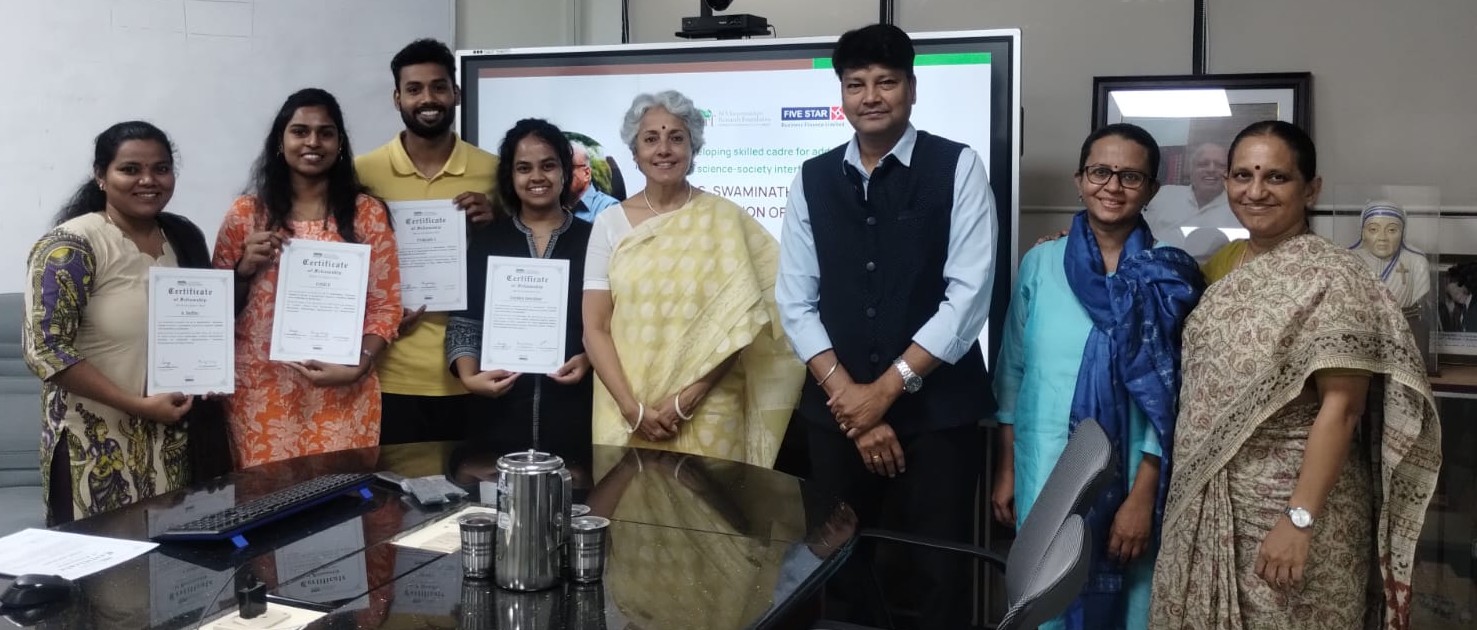
Mr Siva from Five Star with MSS Fellow graduates; Dr Soumya Swaminathan, Dr Gayatri Venkatraman and Dr Rengalakshmi from MSSRF
The next call for applications to the M.S. Swaminathan Fellowship will be announced soon.