
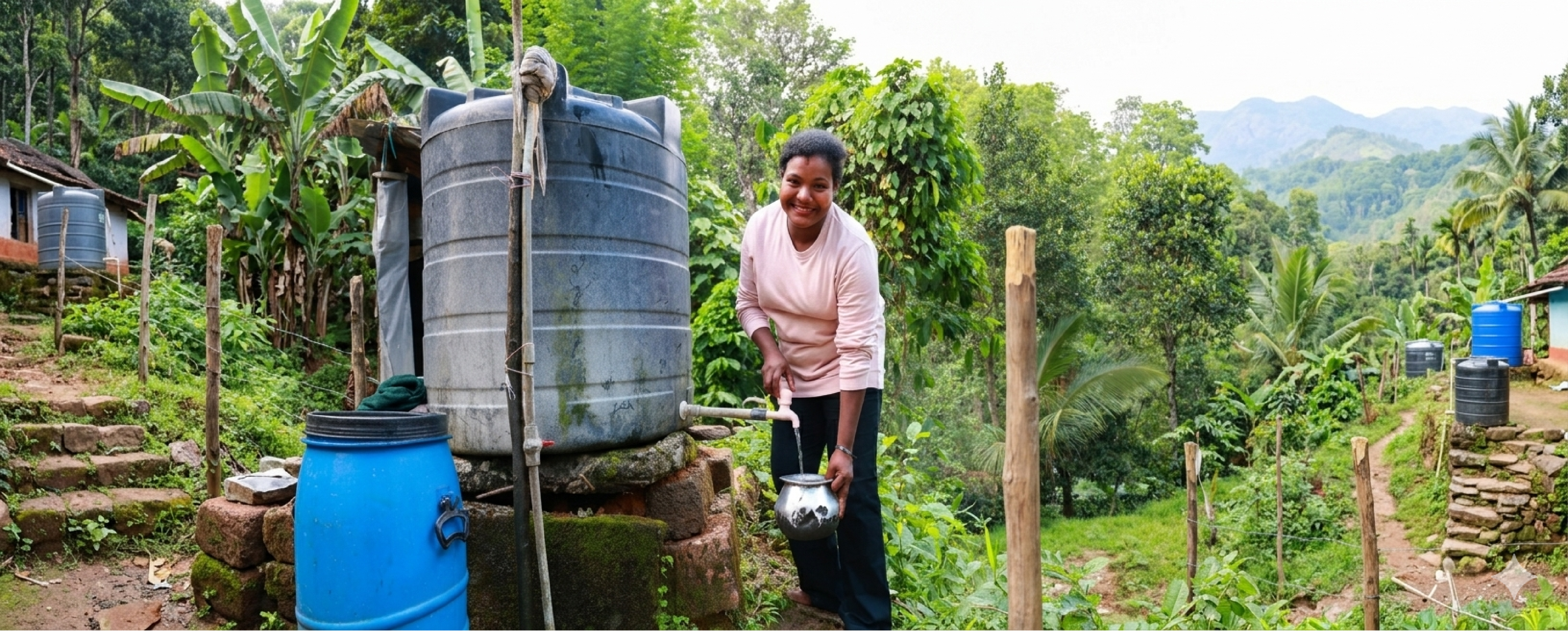
How Access to Water Eased a Woman Farmer’s Burden
In Kairali settlement in Kerala’s Wayanad district, 32-year-old Sobitha begins her day very differently now. A few years ago, her mornings started with a long walk down the valley to fetch water. Today, water flows to her home.
Sobitha, a Paniyan Adivasi woman and a single parent of two, depends on homestead farming and daily wage labour for a living. For years, lack of safe drinking water shaped every part of her day. She would wake up at 5 a.m., spend up to two hours collecting water, and then rush to nearby coffee estates for work. Many days, she skipped breakfast to reach on time.
Evenings brought no rest. She had to make the same trip again.
“Water was always a worry,” she recalls.
The shortage did not just affect health. It also reduced her ability to farm. “Many of my crops dried because there was not enough water,” she says.
Sobitha’s story reflects the burden that many rural women farmers carry. They manage farms, households, and caregiving, often without basic services like water. As the world marks the International Year of the Woman Farmer, her experience shows how access to water is central to women’s dignity, health, and livelihoods.
A shift came in 2014, when the M. S. Swaminathan Research Foundation (MSSRF), with support from the Department of Science and Technology, set up a community drinking water system in the settlement. A well was built in the valley, and water was pumped to an overhead tank on higher ground. Local residents, through their Ooruvikasana Samithi, helped identify and donate land for the project. While the project ended in 2015, local community members like Sobhita still benefit from it.
Today, the system serves around 80 households. For Sobitha, the change has been life-altering.
Reliable water has improved health, reduced daily drudgery, and strengthened her small farm. What was once a cycle of scarcity has turned into a measure of stability.
“For women like Sobitha, access to water is not just about convenience. It is about control over their time, their work, and their future,” said Dr. Niraj Joshi, Director of the MSSRF’s Community Agrobiodiversity Centre in Wayanad. “Our work focuses on reducing this daily drudgery, especially for women, and easing time poverty. When women have more time, they can make better food choices for their families, reduce stress, and take better care of their own well-being.”
Vipindas P is a Post Doctoral Fellow and Noushique P M is a Development Associate at Community Agrobiodiversity Centre, MSSRF, Wayanad.