MSSRF Annual Conference 2026
Event | 7 to 8 August 2026
Building Gender-Just Food, Land and Water Systems: MSSRF Annual Conference 2026
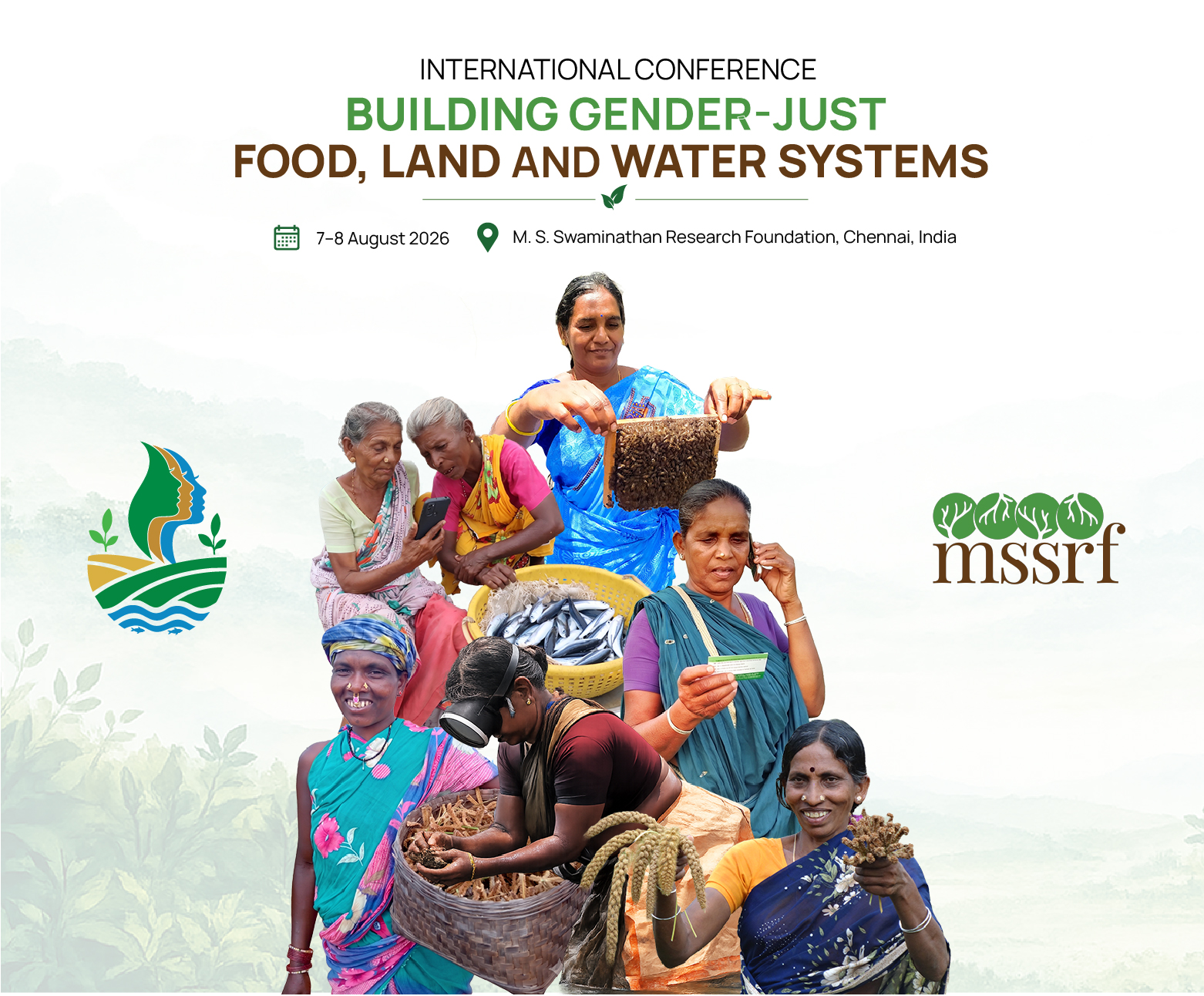
The latest edition of the M S Swaminathan Research Foundation's Annual Conference will be held in Chennai on 7–8 August 2026. This year's theme is “Building Gender-Just Food, Land and Water Systems.”
The international conference is being convened in the context of the International Year of the Woman Farmer, a landmark global observance that recognises the indispensable contributions of women to agriculture, fisheries, pastoralism, biodiversity conservation, food and nutrition security, and sustainable rural livelihoods.
About the International Conference
The MSSRF Annual Conference 2026 aims to spotlight women' central role across food, land and water systems worldwide. As farmers, fisherwomen, pastoralists, forest dwellers, entrepreneurs, caregivers, innovators, and custodians of traditional knowledge, they contribute significantly to food production, natural resource management, and community well-being. Yet, despite their critical role, women continue to face systemic barriers in accessing land, water, finance, technology, markets, information, and decision-making spaces.
The conference also draws inspiration from the International Year of Rangelands and Pastoralists, highlighting the important role of women in pastoral systems, livestock management, grassland conservation, and climate adaptation. At a time when climate change, biodiversity loss, environmental degradation, food insecurity, malnutrition, and social inequalities are becoming increasingly interconnected, women are emerging as leaders of transformative change. Across agricultural landscapes, forests, coastal ecosystems, mountains, drylands, and wetlands, women are developing innovative solutions that strengthen resilience, sustain biodiversity, improve nutrition, and create sustainable livelihoods.
Building upon M S Swaminathan Research Foundation’s vision of an equitable, sustainable, and nutrition-secure future, this conference seeks to provide a global platform for women farmers, fisherwomen, pastoralists, researchers, policymakers, development practitioners, entrepreneurs, civil society organizations, youth leaders, private-sector actors, and international agencies to exchange experiences, share innovations, build partnerships, and co-create pathways toward gender-just food, land, and water systems.
Programme: 7 August
The inaugural session will set the global context of the International Year of the Woman Farmer and emphasise the central role of women in achieving food security, nutrition security, biodiversity conservation, climate resilience, and sustainable development. The session will highlight women’s contributions across agriculture, fisheries, pastoral systems, natural resource management, entrepreneurship, and community leadership while exploring pathways to strengthen women’s agency, rights, and participation in decision-making.
Women have long been custodians of seeds, biodiversity, traditional knowledge, and local food systems. This session will explore the critical role of women in conserving agricultural biodiversity, promoting neglected and underutilised species, sustaining traditional ecological knowledge, and strengthening climate-resilient farming systems. Discussions will focus on agroecological approaches, nutrition-sensitive agriculture, community seed systems, ecosystem restoration, and biodiversity-based livelihoods.
This session will highlight the often-unrecognized contributions of women in the governance of, coastal ecosystems, pastoral systems, fisheries, and natural resource governance. The session will explore how women contribute to ecosystem stewardship, biodiversity conservation, livelihood security, and climate adaptation across diverse waterscapes.
Women experience climate change in unique ways because of their multiple roles in agriculture, food production, water management, caregiving, and household well-being. This session will examine the impacts of heat stress, climate variability, environmental degradation, and health risks on women and explore pathways for adaptation, resilience-building, and social protection.
This session brings together the current Hema Ramachandran Fellow, Mina Swaminathan Media Fellows, and Green Stewards to share their journeys of learning, leadership, and community action. Through brief reflections on their experiences in biodiversity conservation, sustainable agriculture, science communication, and grassroots innovation, the speakers will highlight how MSSRF’s fellowship and stewardship programmes are nurturing a new generation of changemakers committed to advancing ecological sustainability, inclusive development, and the Foundation’s pro-poor, pro-women, and pro-nature vision.
Veppathin Veriyaattam is an original Kattaikuthu production that brings the story of rising heat and climate change to the stage. Through storytelling, music, songs, dance, humour, and audience interaction, the performance explores how extreme heat is affecting our everyday lives.
Children, outdoor workers, farmers, older people, pregnant women, and communities with limited access to shade and cooling are among those facing the greatest risks. More than a performance, Veppathin Veriyaattam invites audiences to understand the changing climate, reflect on its impacts, and imagine how we can build more resilient communities together.
Programme: 8 August
Women are increasingly emerging as entrepreneurs, innovators, and leaders across agri-food value chains. This session will examine how biotechnologies, digital technologies, artificial intelligence, financial inclusion, producer organisations, and market innovations can strengthen women-led enterprises and create sustainable livelihood opportunities. Successful models of women’s entrepreneurship and technology-enabled development will be showcased.
The concluding technical session will focus on the policies, institutions, and collective actions needed to achieve gender-just food, land, and water systems. Discussions will address women’s rights to land, water, technology, finance, and markets while highlighting the role of self-help groups, cooperatives, producer organisations, community volunteers, and civil society institutions in advancing sustainable development
and social transformation.
The valedictory session will synthesize the key lessons, experiences, innovations, and recommendations emerging from the conference. This will result in a policy note on “Gender-Just Food, Land and Water Systems”, which will articulate a shared vision and action agenda for strengthening women’s leadership, advancing gender justice, promoting climate resilience, conserving biodiversity, and transforming food, land, and water systems.
An exhibition showcasing women-led innovations for climate resilience, biodiversity conservation and sustainable development.
Media Delegates
She is a Senior Assistant Editor at Times of India Digital, where she covers special reports on gender, environment, caste, rural development, agriculture, urban infrastructure, politics, and social policy. With over 20 years of experience across print, electronic, and digital media, she is known for investigative and in-depth journalism on issues that shape society. Her work has earned recognitions including the Chamelidevi Jain Award, the Ramnath Goenka Excellence in Journalism Award, and the Asia Journalism Fellowship.
She is an award-winning journalist reporting on public health, environment, development, and women, with a strong focus on South Asia. Her work often examines the impacts of climate change on local communities, alongside data-driven, investigative, and development stories. Based in Pune, she brings more than a decade of experience across television, digital, and print. Disha holds an MA in Science, Environment and Medicine Journalism from Columbia University.
She is a senior journalist with over a decade of experience and currently serves as Kerala Bureau Chief at The News Minute. Alongside leading editorial coverage in Kerala, she focuses on climate change, gender and migration, biodiversity and environmental governance. She has also contributed to Mongabay India and Dialogue Earth. Haritha is a Danida Fellow, having participated in the Danida Fellowship Centre's international training programme in Copenhagen in 2025 on reporting climate change in an era of misinformation. She subsequently reported from COP30 in Belém, Brazil. She is also a four-time Earth Journalism Network (EJN) Fellow, having been selected for different national and international fellowships.
He is an independent journalist from Arunachal Pradesh with more than a decade of experience covering hydropower, politics, development, and culture across India’s northeast. His reporting focuses on the lived realities of indigenous communities and the ways rapid change is reshaping remote regions that are often overlooked in national discourse. He is also a Pulitzer Center grantee and the inaugural recipient of the Kalyan Barooah Award for Print Media.
Sahana is a science and environmental journalist with an eye on global change. She is the Associate Editor at Nature India and a co-founder of the Science Journalists Association of India. She blends field reporting with research, policy, and data to turn complex science into accessible public storytelling. In 2023, she was a Journalist-in-Residence at the Max Planck Institute for History of Science, Germany, focusing on Indian Ocean science history, and leads Solutions Journalism Network's climate solutions literacy projects in India.
Sayantan is an award-winning independent science journalist, a member of Labhopping Science Media Forum and an Assistant Professor at the Centre for Writing & Critical Pedagogy, Alliance University, Bengaluru. Their work sits at the intersection of science, gender, sexuality, caste, and health. They have written widely for national and international platforms and authored children’s books that make science more accessible. They have written widely for national and international platforms, published academic papers, and authored children’s books that make science more accessible.