
The quiet power of seed keepers in Odisha’s community seed banks
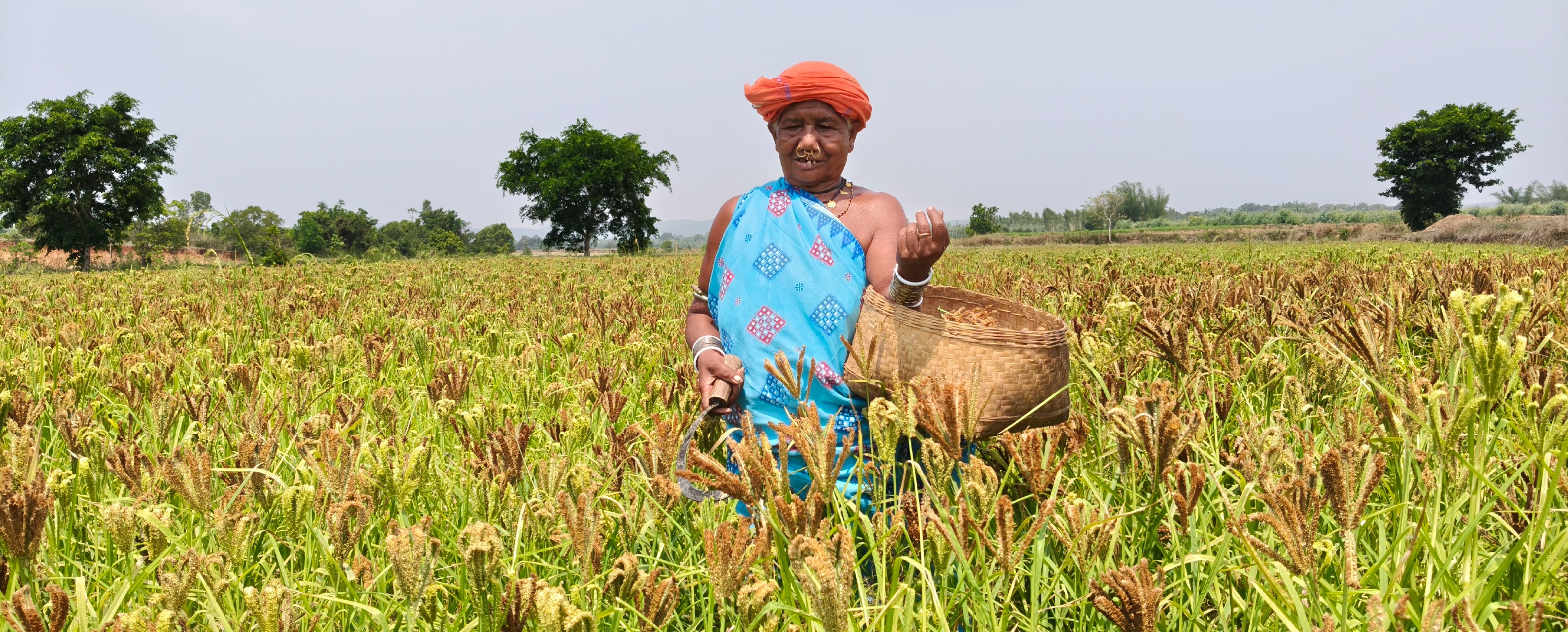
In Nuaguda village in Odisha’s Koraput district, 65-year-old Dutika Mathpadia has learnt to trust a handful of seeds saved from her own harvest, or those shared through the village’s Community Seed Bank (CSB).
“There are two sources for me,” says Dutika. “My own saved seeds and those from the CSB. I trust both. But I am not confident about seeds from the market.”
For Dutika, seeds are not just about yield. They carry taste, memory, and assurance. Each season, she weighs her choices carefully. Last year, she cultivated Lolat Dhan, a paddy variety accessed through the CSB. This year, she has returned to Umuriachudi, a traditional rice once grown in her fields, still valued in the region for its flavour. Alongside, she grows red gram sourced from the CSB, known locally for its quality.
Across Koraput, such stories are quietly common. Many women farmers today cultivate a mix of paddy, millets, vegetables, and spices balancing household consumption with market sales. While vegetable seeds often come from shops, the foundation of their farming lies in traditional seeds, mostly accessed through the CSB or preserved at home.
Dutika joined the CSB four to five years ago, drawn by a simple motivation: better food and health. “The millet we get from the CSB is tasty and good for the family,” she says.
Over time, the CSB has become both a source and a support system. In August 2025, she received three kilograms of Bati Mandia millet seeds. Equally important, the CSB has strengthened her own practice of saving seeds. The paddy she grows now comes from seeds she conserved from the previous harvest.
Seed saving, she explains, is an inherited skill. After harvest, seeds are dried, stored in clay pots, layered with straw, and sealed with cow dung, a method that protects them from pests and moisture.
“If a variety is not available in the CSB, I use my own seeds,” she says. “That is better than depending on others.”
Community seed banks are quiet yet powerful spaces rooted in trust, knowledge, and collective care. Farmers contribute seeds from their own fields, carefully selected, cleaned, stored, and shared. Often, it is women like Dutika who safeguard these living treasures, preserving them in clay pots, on kitchen shelves, or in community spaces, thus protecting biodiversity, nutritional diversity, and cultural memory across generations. These seed banks ensure that when floods, droughts, pests, or crop failures strike, farmers are not left helpless.
Dutika recalls how earlier, after long hours of labour, she would spend evenings manually processing rice and millets before cooking late into the night. Today, with access to processing machines and support from the CSB, that routine has eased.
There has also been an economic shift. Dutika sells her produce directly at the mandi using her own card, earning better prices and retaining control over her income.
Yet, beneath these gains lies a shared concern. “Youth are moving away from agriculture,” Dutika says. “We are trying to teach them. But they are not interested. If they do not continue, we will lose this wealth.”
It is this uncertainty that the M.S. Swaminathan Research Foundation (MSSRF) is trying to address by working closely with the local communities and the seed banks and raising awareness about them. Most recently, in collaboration with the Fridtjof Nansen Institute, MSSRF has developed www.communityseedbanks.in — a national platform mapping over 480 community seed banks across India envisioned to evolve into a rich repository connecting farmers, community seed bank networks, researchers, and institutions.
“Community seed banks have always existed as local systems of resilience. The digital platform makes that invisible work visible and aims to connect it to larger conversations on biodiversity and food security,” said Dr. Rengalakshmi R, Executive Director, Area Operations at MSSRF.
Regine Andersen, Research Professor at the Fridtjof Nansen Institute, agrees. “By mapping and connecting these community seed banks, we are not only preserving knowledge but also enabling collaboration and learning at scale,” she said adding that the digital platform and the atlas are an evolving resource. “We hope that more stakeholders come forward to make use of this platform and populate it with relevant information,” she added.
Back in Kumbharaguda, such ideas translate into something simpler. Dutika continues to save, sow, and share. Each season, her choices reaffirm a way of farming that values taste as much as yield, and continuity as much as change.
“I will continue to conserve as long as I am here,” Dutika says.
DIVERSIFARM-India project aims to improve food, nutrition, and livelihoods for small farmers by strengthening seed systems through community seed banks. The project is led by FNI and MSSRF.