
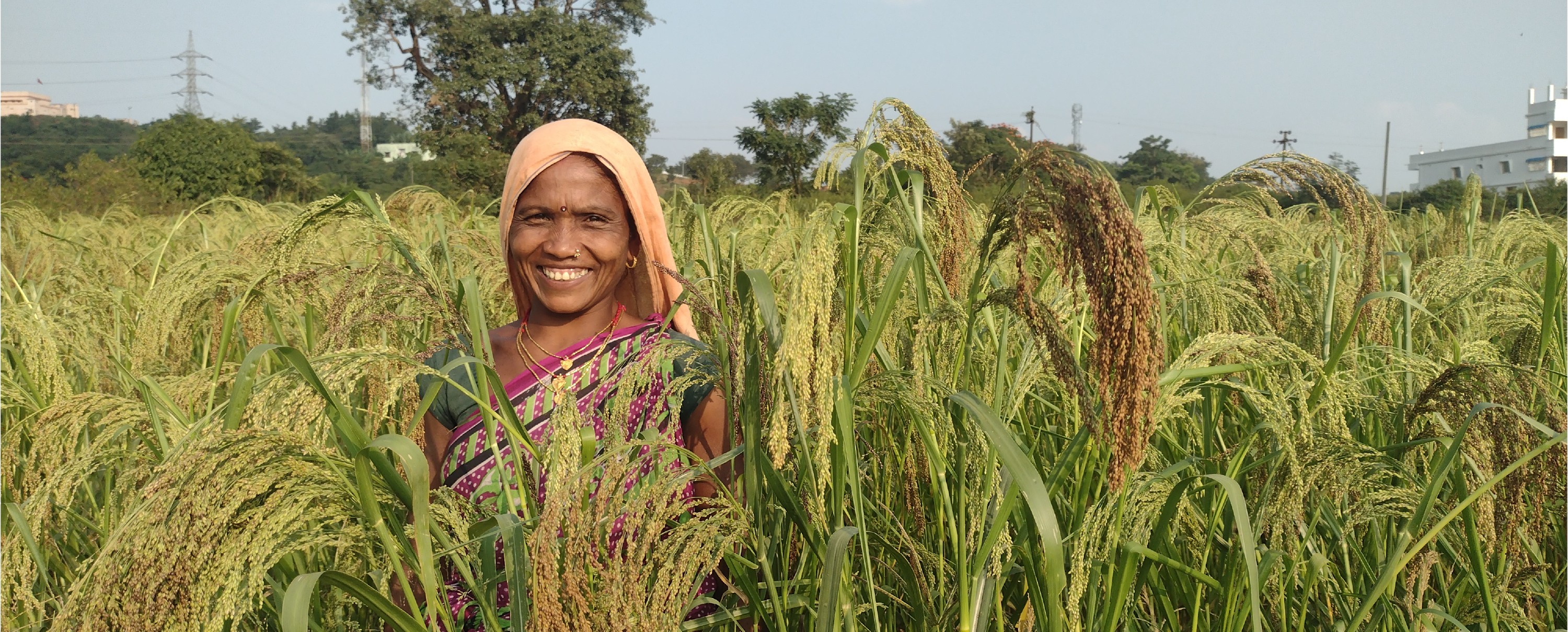
In Odisha, a Woman Farmer Finds Strength in Millets
Thirty-two-year-old Chita Chendia wanted an identity of her own. She worked on her 8.5 acres farm, mostly by herself, growing paddy, vegetables, and millets for her family. Yet, she felt that her family and the community saw her only as a homemaker.
Her days were full. She managed household chores, cared for three children, and did hard farm work. She wanted to do more, but the lack of recognition held her back. That began to change when she was introduced to new ways of growing millets.
In her village, Machhara in Odisha, women are rarely recognised as farmers. While this makes access to credit, schemes and subsidies hard to come by, they also suffer due to limited access to training and resources. Millet farming, especially after harvest, is slow and tiring work. It takes time and energy, leaving little space to grow beyond basic needs. Chita knew this well but stayed determined to move ahead.
In 2018, the M.S. Swaminathan Research Foundation (MSSRF) brought new farming practices to her village. Chita was quick to learn. Earlier, millets were grown using the broadcasting method. She was trained in line sowing, the System of Millet Intensification (SMI), and the use of bio-inputs. These methods were more efficient. She also learned to use tools like the cycle weeder, which reduced physical strain and saved time.
Along with other women, Chita received training in seed production for finger millet, little millet, foxtail millet, and traditional paddy. MSSRF also helped set up a multi-grain processing unit run by the Shabari Producer Group. This gave women a shared space to process, grade, and pack millets, turning a basic crop into a source of income.
“MSSRF’s support gave me the confidence to produce seeds and guide other women,” Chita says.
Today, Chita grows finger millet on three to four acres each year for seed production. She produces 36 to 42 quintals, which she sells to the Odisha State Seed Corporation at good rates. She also works at the Machhara processing unit and earns extra income through value addition.
Her impact goes beyond her own farm. She encourages other women to use tools that reduce manual labour. So far, 56 farmers in her area now grow millets across 91 acres. She and her husband also prepare bio-inputs such as vermicompost, jeevamrut, farmyard manure, and bijamrut for the village.
Chita’s journey shows a clear shift. She has moved from being an unseen worker to a seed producer, trainer, and a strong voice for millet farming in her community.
Neeranjan Gauda is a Development Coordinator at MSSRF, Tribal Agrobiodiversity Centre, Jeypore.