Dr. Rupesh Bhomia
Home > About us > People > Founder > MSS@100 > The M. S. Swaminathan Centenary Lecture Series > Dr. Rupesh Bhomia
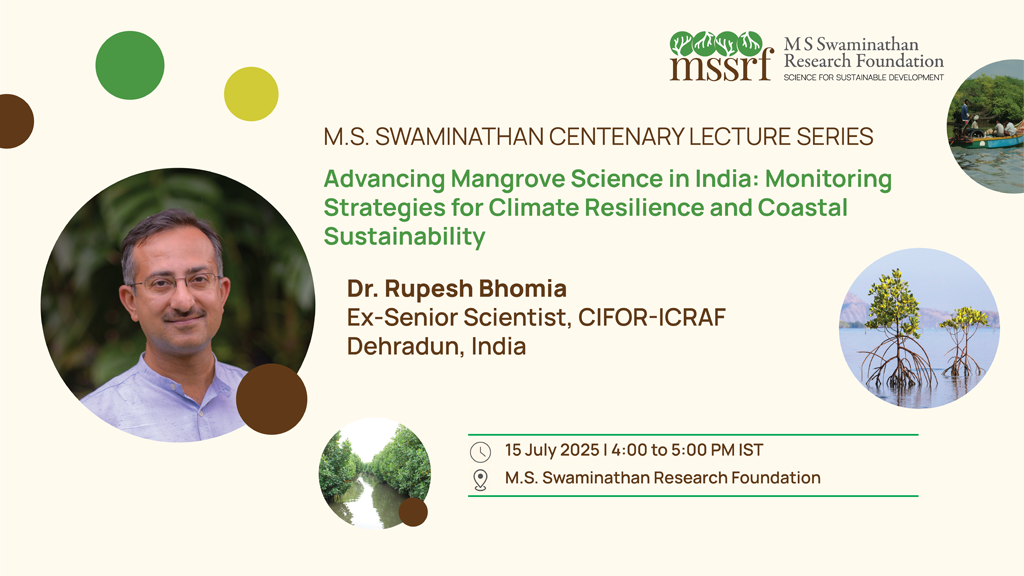
Speaker: Dr. Rupesh Bhomia, Ex-Senior Scientist, CIFOR-ICRAF, Dehradun, India
Time and Date: Tuesday, 15 July 2025
Talk: ‘Advancing Mangrove Science in India: Monitoring Strategies for Climate Resilience and Coastal Sustainability‘
Mangrove ecosystems, critical coastal habitats providing essential ecological, economic, and societal benefits, face increasing threats from human activities, extreme weather, and climate change, making them vital components of nature-based solutions for carbon sequestration and coastal resilience. Effective long-term monitoring is essential to understand the ecological processes governing nutrient cycling, carbon storage, and habitat connectivity in these dynamic environments, as environmental shifts and extreme events disrupt the delicate balance that allows healthy mangroves to function as efficient carbon sinks. This presentation explores evolving paradigms in mangrove research, highlighting a pioneering CIFOR-ICRAF initiative in collaboration with state forest departments to establish a comprehensive long-term monitoring network across mangrove sites, providing critical insights into coastal dynamics under climate change and anthropogenic pressures. Such integrated monitoring efforts are indispensable for understanding mangroves' role in climate mitigation and adaptation, assessing ecosystem health and resilience, and guiding evidence-based management decisions that enhance their capacity to mitigate climate impacts and contribute to sustainable coastal development.
Speaker: Dr. Rupesh K. Bhomia is an accomplished environmental scientist with over two decades of transdisciplinary research and applied experience in tropical wetlands, biogeochemistry, and climate resilience. He holds a Ph.D. in Soil and Water Sciences from the University of Florida (Best Dissertation Award, 2013) and dual Master's degrees from the University of Oxford and Jawaharlal Nehru University. His work integrates field-based research, teaching, science-policy engagement, and capacity development across more than a dozen countries in Asia, Africa, and the Americas.
Watch full video below: